

Trade has returned to the center of global commodity discussions.
Tariffs, geopolitical tensions, and technical barriers are increasingly shaping how agricultural products move across borders, and the nut and dried fruit sector is no exception.
In a recent article by the International Nut and Dried Fruit Council, trade is described as dominating the conversation. The sector finds itself navigating an environment defined not only by tariffs, but by a growing web of regulatory, technical, and institutional challenges that directly affect how nuts and dried fruits are produced, traded, and consumed worldwide.
Yet when we look closely at the data and structure of the sector, a more precise picture emerges:
trade matters, but complexity, not scale, is the defining constraint.
A Large, Global Market, But One That Is Structurally Fragmented
By most measures, global trade in nuts and dried fruits is substantial.
According to UN Comtrade, the combined trade value of shelled and in-shell nuts is estimated at approximately US$35 billion. Broader market assessments, which incorporate downstream consumer value, place the global tree nut market at more than US$50 billion, with projections suggesting it could more than double by 2032.
However, scale alone does not capture the sector’s defining feature: fragmentation.
- Around 70 producing countries participate in global nut and dried fruit production
- Trade flows extend to more than 200 importing countries
- Products move in both shelled and in-shell forms, each subject to different regulatory and logistical constraints
This creates a uniquely interconnected market, one with common needs, but highly complex interdependencies.
Trade Flows Are Central and Increasingly Volatile
The nut and dried fruit sector is profoundly dependent on trade flows.
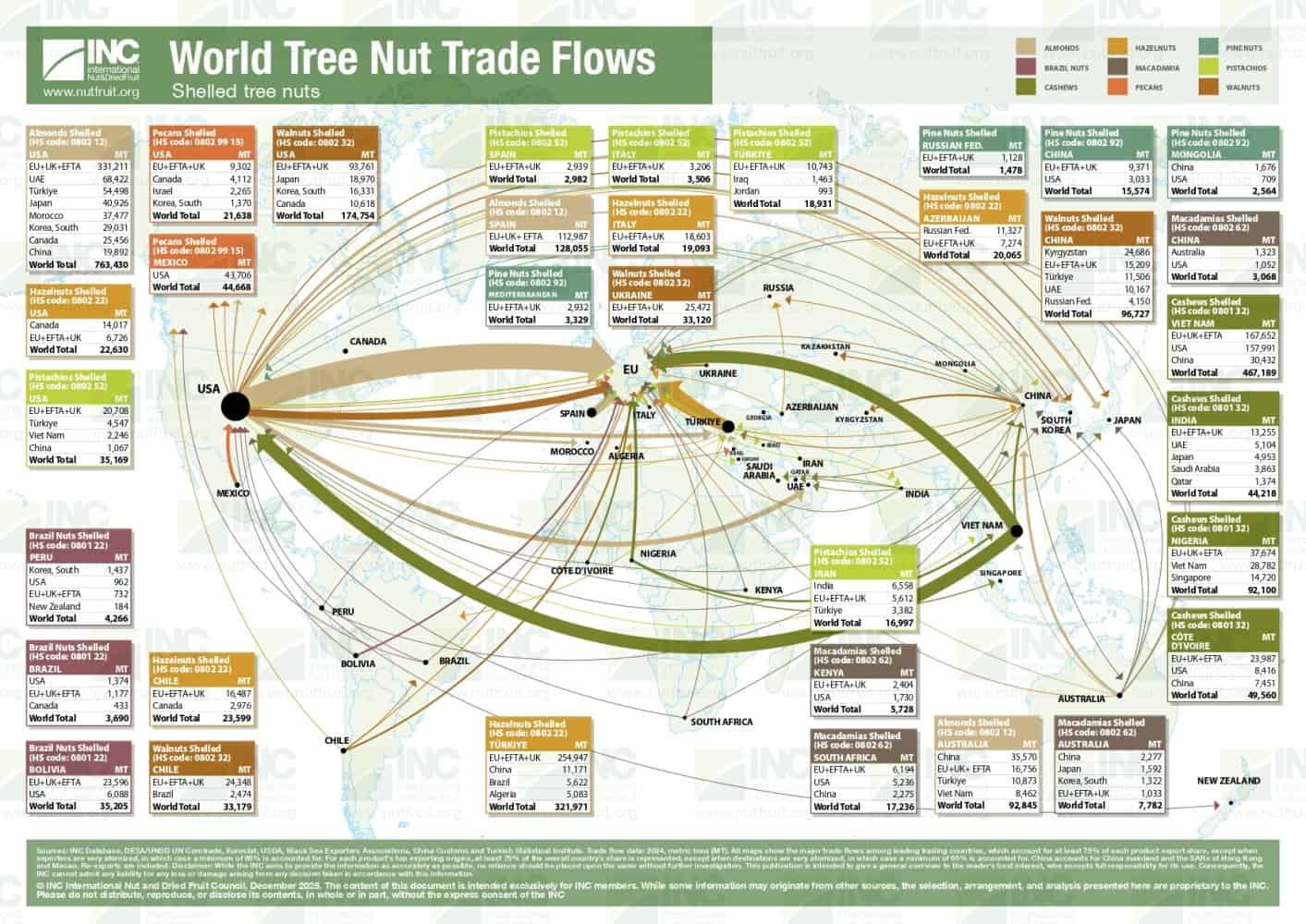
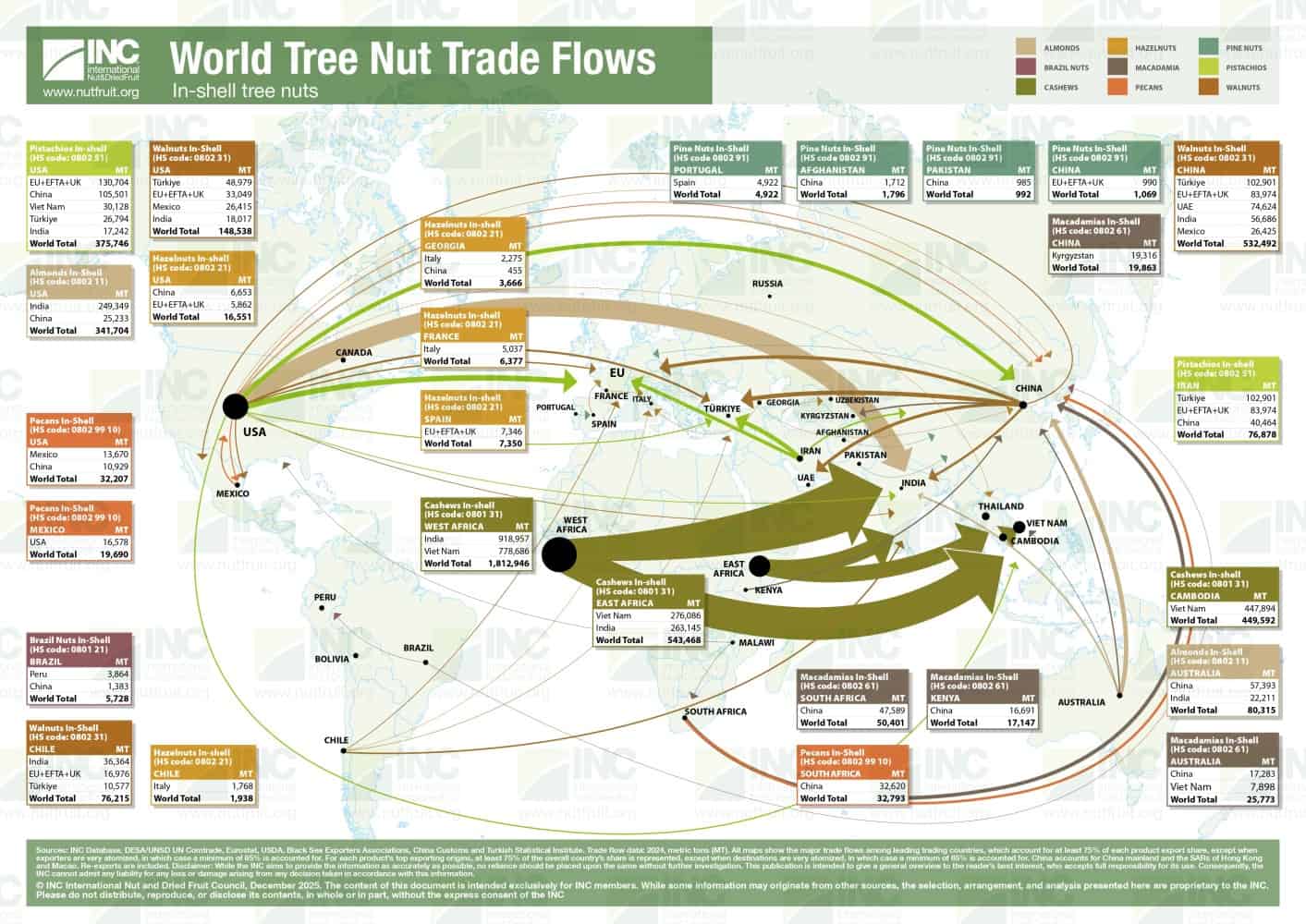
This dependence is clearly illustrated by the INC’s biennial trade maps, which show dense, multi-directional global movements for both shelled and in-shell products.
Recent trade tensions have amplified volatility across these flows. For producers, processors, and importers alike, the past few years have underscored a critical reality: diversification is no longer optional.
While tariffs often dominate headlines, they are only part of the story.
Tariffs Get Attention, Technical Barriers Create Friction
One of the key insights from the INC analysis is that non-tariff barriers frequently pose a greater and more persistent challenge than tariffs themselves.
These include:
- Documentation and certification requirements
- Phytosanitary rules
- Maximum residue limits (MRLs)
- Contaminant thresholds
- Reference pricing mechanisms
- Inconsistent application of standards at borders
Unlike tariffs, these barriers are often:
- Harder to negotiate
- Slower to resolve
- Less visible in public trade discussions
Digging deeper into these issues frequently reveals gaps in understanding, not only of production practices, but of risk assessment and scientific context. In some cases, a lack of trust or harmonization, rather than explicit protectionism, is the real obstacle.
Why Data, Science, and Standards Matter More Than Headlines
A recurring theme in the INC article is the strategic role of data.
Science-based evidence has proven essential in:
- Adjusting unrealistic standards
- Demonstrating regional feasibility (or infeasibility) of certain requirements
- Supporting equivalence approaches that align with real-world production conditions
Recent work on heavy metals, for example, has shown how empirical data can clarify why certain standards may not be achievable for specific commodities or regions, and why blanket assumptions often fail.
In trade negotiations, data answers risk questions, and risk is the foundation upon which standards are built. Without credible data, even well-intentioned arguments struggle to gain traction.
Why Nuts & Dried Fruits Often Lose Visibility in Trade Talks
Despite their economic value and global reach, nuts and dried fruits are frequently overshadowed in broader trade negotiations.
Bulk commodities such as corn, soybeans, and dairy benefit from:
- Longer trade histories
- Larger headline volumes
- More established policy frameworks
By comparison, nuts and dried fruits are rarely “top of mind” for negotiators, even though their trade networks are more complex and often more sensitive to regulatory disruption.
This mismatch increases the risk of the sector becoming collateral damage in wider trade disputes.
Collaboration as a Strategic Response
The INC highlights collaboration as one of the sector’s most effective tools.
Through engagement with:
- Codex Alimentarius
- National and regional trade associations
- Industry bodies across the U.S., Europe, Türkiye, and China
the sector has been able to elevate its concerns and demonstrate its broader economic contribution.
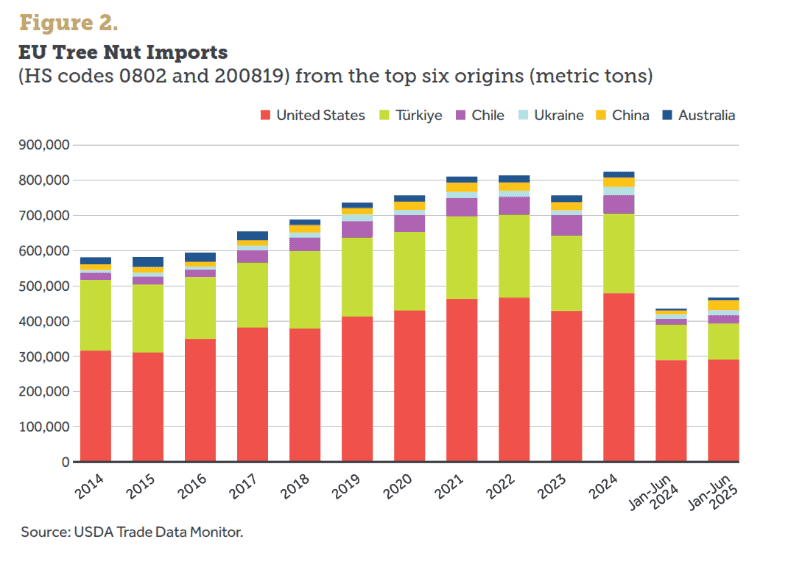
A clear example is the role of coordinated engagement during US–EU bilateral trade negotiations, where data-driven advocacy helped reinforce the importance of nut imports for European value addition, employment, and downstream industries.
Why This Matters for the Industry
Trade may dominate the conversation, but for nuts and dried fruits, the real challenge lies in managing complexity.
- A fragmented production base
- Multi-layered regulatory environments
- High sensitivity to technical standards
- And limited visibility in macro trade negotiations
Together, these factors shape outcomes far more than tariffs alone.
For producers, traders, and importers, the competitive edge increasingly comes from:
- Understanding regulatory risk
- Anticipating technical barriers
- Engaging with credible, science-based data
- And participating in coordinated industry action
Engaging With the Right Information
As the current trade environment grows more tense, uncertainty becomes a constant. Agriculture has always adapted to natural variability, but human-made volatility adds a different kind of pressure, one that directly affects investment, sourcing, and long-term planning.
In this context, engaging with the right information is not optional.
It is the foundation for navigating a market where trade conversations are loud, but where outcomes are ultimately shaped by standards, data, and cooperation.
Conclusion: Trade Dominates the Conversation, Complexity Shapes the Outcome
Trade discussions will continue to dominate headlines in the nut and dried fruit sector.
Tariffs, geopolitical tensions, and regulatory debates are now a permanent feature of the landscape.
But as the data and structure of the sector show, outcomes are rarely determined by tariffs alone.
Instead, the defining challenge lies in complexity:
- fragmented global production,
- dense and shifting trade flows,
- non-tariff barriers that are harder to resolve than headline duties,
- and a sector that remains underrepresented in broader trade negotiations.
For nuts and dried fruits, success in this environment depends less on reacting to political noise and more on understanding how standards, data, and cooperation shape access to markets in practice.
Trade may dominate the conversation, but information, science, and coordination determine who can navigate it effectively.
Stay Informed Beyond the Headlines
At Rotterdam Commodity Trading, we track developments across the global nut and dried fruit sector with a focus on trade flows, regulatory dynamics, and market structure, not just the headlines.
Our market updates and analysis help traders, importers, and industry professionals understand where real risks and opportunities are emerging.
Subscribe to our updates to stay informed on global nut and dried fruit markets, with context, data, and clarity beyond the daily trade conversation.
 We use cookies to ensure you get the best experience on our website. For more information, please read our Privacy Policy.